
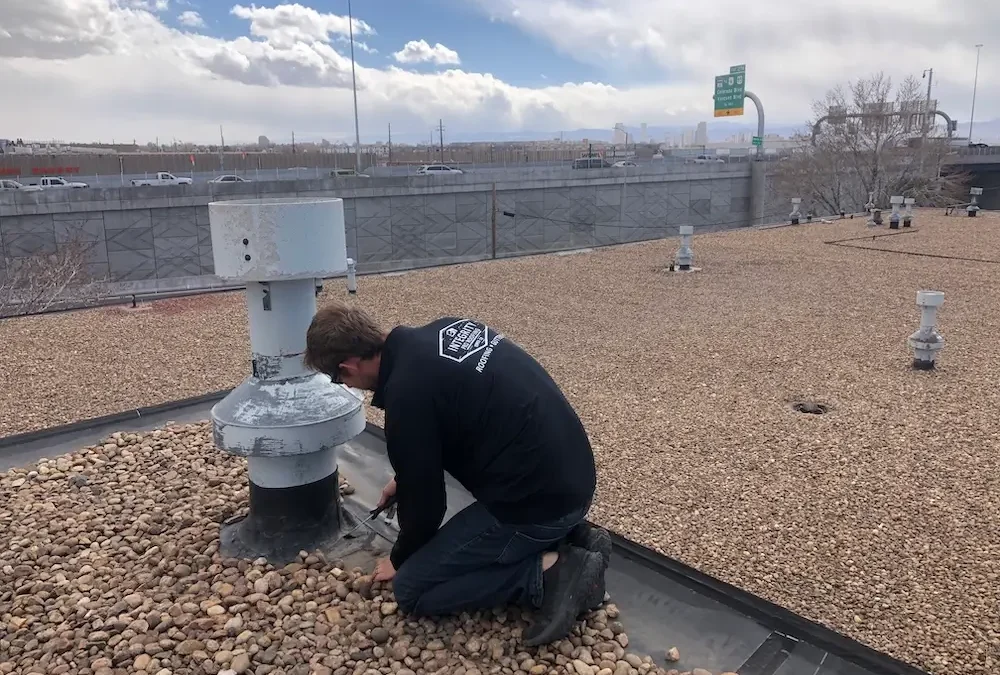
A commercial flat roof leak rarely arrives at a convenient time. Maybe a ceiling tile suddenly develops a water stain. Perhaps employees notice dripping after a heavy Colorado storm. Or maybe your maintenance team has been chasing the same frustrating leak for months.
The challenge is that where water appears inside a commercial building isn’t necessarily where it entered the roof.
Commercial flat and low-slope roofing systems contain seams, flashing, penetrations, drains, HVAC curbs, transitions, and other details that can allow moisture into the assembly. Water can then travel beneath the roofing system before finally becoming visible inside.
That’s why effective commercial flat roof leak repair in Colorado starts with finding the actual source rather than simply patching the area above the visible leak.
Here’s what commercial property owners and facility managers should know about common leak causes, repair costs, professional leak detection, and when a larger roofing solution may make more sense.
What Causes Commercial Flat Roof Leaks?
Commercial roof leaks can develop for many reasons, and Colorado’s demanding climate only adds to the challenge.
Damaged Membranes
TPO, PVC, EPDM, and other membrane roofing systems can become punctured or damaged by storms, rooftop traffic, dropped tools, equipment servicing, and general deterioration.
Even a relatively small puncture can allow moisture beneath the membrane.
Failed Seams
Single-ply commercial roofs rely on properly constructed seams to create a continuous protective surface. Age, installation problems, thermal movement, or physical damage can compromise those seams.
Once a seam begins separating, wind-driven rain and melting snow may find a path into the roofing assembly.
Flashing Problems
Flashing protects some of the most vulnerable parts of a commercial roof, including edges, walls, curbs, penetrations, and transitions.
Loose, deteriorated, or improperly installed flashing is a common source of commercial roof leaks.
Rooftop Penetrations
Commercial roofs frequently contain HVAC equipment, vents, pipes, electrical components, skylights, roof hatches, and other penetrations.
Every penetration creates a detail that must remain properly sealed. As roofing materials and sealants age, these areas can become vulnerable to water intrusion.
Drainage and Ponding Water
Flat roofs aren’t completely flat. They’re designed with enough slope to direct water toward drains, scuppers, or gutters.
When those drainage systems become clogged or the roof develops low areas, water can remain on the surface. Persistent ponding places additional stress on roofing materials and may expose existing weaknesses.
Previous Repairs
Temporary patches and older repairs can eventually deteriorate. In some cases, repeatedly repairing the visible symptom without identifying the original source can make diagnosing future leaks even more difficult.
Why Colorado Commercial Roofs Develop Leaks
Colorado commercial roofing systems operate in a particularly demanding environment. Hail is one of the most obvious concerns. A severe storm can puncture membranes, damage flashing, affect coatings, and dent metal roofing components. But hail isn’t the only problem.
Colorado’s elevation creates intense UV exposure that can accelerate material deterioration. Significant temperature swings cause roofing components to repeatedly expand and contract. During winter, accumulated snow eventually melts, and that water must move efficiently through the building’s drainage system.
Freeze-thaw cycles can make existing vulnerabilities worse. Moisture enters a small opening, freezes as temperatures fall, expands, and can gradually enlarge the damaged area.
High winds add another source of stress, particularly around perimeter details, flashing, seams, and other vulnerable areas.
These conditions make preventative inspections especially valuable for commercial buildings in Denver and throughout Colorado.
How Professionals Find the Source of a Commercial Roof Leak
Commercial roof leak detection requires more than finding the wet ceiling tile and climbing directly above it. Water moves. It can enter through one section of the roof, travel along insulation, decking, structural components, or other materials, and appear inside the building several feet away.
Professional leak detection starts by gathering information.
Interior Investigation
The contractor may begin inside the building by examining water stains, ceiling damage, moisture patterns, and the timing of the leak.
Does it happen during heavy rain? Only when the snow melts? During wind-driven storms? After HVAC equipment is serviced? Those details can provide important clues.
Rooftop Visual Inspection
Next, the contractor evaluates the roof itself, looking for potential entry points such as:
- Open seams
- Membrane punctures
- Damaged flashing
- Deteriorated sealants
- Problems around HVAC curbs
- Drainage issues
- Ponding water
- Damaged roof coatings
- Previous repair areas
Understanding how the roof is constructed helps narrow down potential sources.
Evaluating Water Paths
Experienced commercial roofers don’t just ask, “Where is the hole?” They consider how water could move through the roofing assembly and building structure before becoming visible inside.
This diagnostic approach is particularly important when a building has experienced recurring leaks that previous repairs haven’t resolved.
How Much Does Commercial Flat Roof Leak Repair Cost?
There isn’t one standard price for commercial flat roof leak repair because the cause and extent of damage can vary significantly.
A straightforward repair to an accessible membrane puncture will generally cost much less than addressing widespread wet insulation, damaged decking, multiple failed seams, or complicated flashing around rooftop equipment.
Factors affecting commercial roof repair costs include:
- Roofing system type
- Size of the damaged area
- Accessibility
- Number of leaks
- Amount of wet insulation
- Flashing requirements
- Drainage problems
- Rooftop equipment
- Labor requirements
- Extent of underlying damage
The visible leak is only one part of the equation.
For that reason, commercial property owners should be cautious about accepting repair pricing before the roof has been properly evaluated. An accurate inspection provides a much clearer understanding of both the problem and the appropriate solution.
Repair, Restore, or Replace?
Finding a leak doesn’t automatically mean you need a new commercial roof. If the roofing system is otherwise in good condition and damage is localized, a professional repair may be all that’s necessary.
For an aging but structurally sound roof, restoration or a commercial roof coating may sometimes provide another option. Depending on the existing roofing system and its condition, coatings can address vulnerable areas and extend service life without immediately proceeding to full replacement.
Replacement becomes more reasonable when problems are widespread, moisture has compromised significant portions of the assembly, repairs are becoming increasingly frequent, or the roofing system has reached the end of its practical lifespan.
Integrity Pro Roofing’s approach is to evaluate the entire roof and recommend the solution that makes sense for the building rather than automatically pushing replacement.
Why Recurring Commercial Roof Leaks Shouldn’t Be Ignored
One small leak may not seem urgent, particularly if it only appears during certain storms. But moisture problems rarely improve on their own.
Unresolved commercial roof leaks can eventually affect:
- Roof insulation
- Decking
- Interior ceilings and finishes
- Electrical systems
- Equipment and inventory
- Tenant spaces
- Building operations
Wet insulation can also reduce thermal performance, potentially increasing heating and cooling demands.
Addressing a leak early is usually far easier than addressing the damage that develops after months of moisture intrusion.
Preventing Future Commercial Flat Roof Leaks
The best leak repair is the one you don’t have to make. Routine commercial roof inspections and preventative maintenance can identify developing issues before water reaches the interior.
Property and facility managers should consider scheduling professional roof inspections at least twice annually, typically in spring and fall, as well as following significant Colorado hail, wind, or snow events.
Drainage systems should also be kept clear, and unnecessary rooftop traffic should be minimized. If contractors need roof access to service HVAC or other equipment, designated walkways can help protect vulnerable roofing materials.
Keeping records of inspections, repairs, and roof condition also makes it easier to identify recurring trouble spots and plan future maintenance expenses.
Commercial Flat Roof Leak Repair FAQs
Why is my commercial flat roof leaking?
Common causes include membrane punctures, failed seams, deteriorated flashing, rooftop penetrations, drainage problems, storm damage, and aging roofing materials. A professional inspection is usually necessary to determine the actual source.
Can a commercial roof leak be repaired without replacing the roof?
Yes. Many commercial roof leaks can be repaired when the damage is localized and the overall roofing system remains in serviceable condition. Replacement isn’t automatically necessary because a leak has developed.
Why does my commercial roof only leak sometimes?
Leaks that only appear under certain conditions can be associated with wind-driven rain, snowmelt, ponding water, specific drainage patterns, or temperature-related movement. These intermittent leaks can be particularly difficult to diagnose without professional evaluation.
How quickly should I repair a commercial roof leak?
Commercial roof leaks should be evaluated as soon as practical. Even a small opening can allow moisture to spread into insulation and other building components, increasing the scope and cost of future repairs.
Can hail cause a commercial flat roof to leak later?
Yes. Hail may damage membranes, seams, flashing, and roof coatings without immediately producing an interior leak. Subsequent rain, snowmelt, and freeze-thaw cycles can expose or worsen that damage.
How can I tell where a flat roof is leaking?
The location of interior water isn’t always directly beneath the point of entry. Commercial roofers inspect interior moisture patterns alongside seams, flashing, penetrations, drainage areas, and other rooftop details to trace the likely water path.
Is a roof coating an alternative to commercial roof replacement?
Sometimes. If the existing roof is structurally sound and meets the requirements for a coating system, restoration may extend its useful life. An inspection is necessary to determine whether repair, coating, or replacement offers the best long-term value.
Find the Leak Before It Becomes a Bigger Problem
A leaking commercial flat roof doesn’t automatically require replacement, but it does require an accurate diagnosis.
At Integrity Pro Roofing, we specialize in commercial roofing systems and understand the challenges Colorado buildings face. Our team evaluates the source of the problem, documents the condition of your roof, and provides straightforward recommendations based on what your building actually needs.
Whether you’re dealing with a new leak, a recurring problem no one seems able to solve, or an aging flat roof that needs a closer look, we’ll help you understand your options.
Schedule your complimentary commercial roof assessment with Integrity Pro Roofing today and get to the source of your roof leak.